U.S. Department of Transportation
Federal Highway Administration
1200 New Jersey Avenue, SE
Washington, DC 20590
202-366-4000
The technical part of the visit to London included:
In 2000 the Labor Government announced a 10-year plan "Transport 2010," which was a platform to take a radical look at transport policy. The result was an integrated transport policy that states that: "In an integrated transport system, information is crucial." It supports the idea that the physical elements of the system need to be planned as soon as feasible and that transport must be integrated with other aspects. Trends were not necessarily considered while developing these policies. The focus is on shifting demand to public transport. The concepts have resulted in the Traveline service. Recent political developments led the Deputy Prime Minister to announce a Transport Direct initiative. The title Transport Direct is based on the National Health Services' hotline NHS Direct.
The vision for Transport Direct is to provide an all-embracing, multimodal, planning, ticketing, and alerting multichannel travel information service that is integrated in the future with a smart card for ticketing.
The vision is to provide travel planning for all modes, integrated travel booking, and actually running a real-time information system based on sound historical information.
The government role in Transport Direct is to harness stakeholders, set the pace and direction in terms of targets and audits of the targets, provide standards support, and offer facilitation. More information can be found at: www.dtlr.gov.uk/itwp/transdirect/travinfo/index.htm.
Transport Direct established several target areas:
Following are other ongoing DTLR activities:
The Highways Agency manages the equivalent of the U.S. National Highway System. It includes 2,000 miles of motorways and 4,500 miles of trunk roads. Historically, the Highways Agency was responsible for tactical control and safety of the highway system. Now the Highways Agency is moving toward strategic control, with an emphasis on efficiency, LOS, and real-time information. The key government policy is: "Make better use of the roads we have." In the United Kingdom the police operate the motorways. ITS infrastructure has become a standard for all new projects. Several pilot projects are under way. For example, the M25 Motorway has enforceable, variable speed limits. The benefits are more than a 5 percent reduction in accidents, small reductions in journey times, small increases in throughput, and increased customer satisfaction leading to reduced stress. Ramp metering is being tested on the M27/M3 at six pilot sites, and the benefits assessment is under way. An active traffic management program is being tested on the M4 in Birmingham on a 40-km section of freeway. Detectors are installed every 50 m with a VMS every 500 m. Ramp meters are used, and dynamic use of the shoulder is allowed. Full CCTV coverage is provided.
The strategic management philosophy is to encourage "new driver information services," but there is agreement that infrastructure is still needed, hence the TCC project.
The motorways are fully cabled (copper and/or fiber). That is not the case for trunk roads. Commercial telecommunication services are expanding.
The TCC procurement process took 3.5 years, with 12 to 18 months being used to develop the business case/model. The Highways Agency had to demonstrate that this approach is more efficient than public-sector operations. The project was advertised throughout Europe for expressions of interest, followed by a consultation exercise with the private sector and interested parties. Then there was a two-stage tender process with detailed level of interest (about eight submittals were received). A shortlist of four was invited to submit detailed proposals, which resulted in two final bidders. The best proposal was selected for final negotiations and a best and final offer. Risk assessment of proposals was a key part of the evaluation process, and both final bids were of good quality.
The TCC project will enhance existing Highways Agency infrastructure. The contractor is developing independent systems and networks and is considering cellular communications to the detectors. A single control center will be built in the central region. The system will only cover England, but it will coordinate with the systems in Scotland and Wales.
The estimated types of congestion on trunk roads are:
DTLR/Highways Agency have selected a contractor on the basis of performance requirements to design, build, operate, maintain, and transfer. The contract did not have functional specifications, but rather requirements. It is a 10-year contract worth 160 million pounds, and a team called "Traffic Information Services" consisting of Serco and Halcrow Fox and several subconsultants was selected. The contract requires the center to be operational by 2003 and to continue operations until 2011. Commercial services revenues are capped. Below the cap, the contractor retains 100 percent of the revenue; above the cap, the revenue is split 50/50 between the contractor and government.
The Travel Information Highway is the method of sharing roadway data between agencies and service providers. It serves as a national data exchange and can be visited on the Internet at www.tih.org.uk. A demonstrator was built by the Highways Agency, and the TCC is being tasked to support its development. The TCC must use it, but will not own it. The Highways Agency is currently considering a video information highway. Twenty of 32 police control centers have a CCTV system. The main considerations are technology, data ownership, privacy, security, and acceptable policies.
The Highways Agency participates in the implementation of several European projects. The Centrico project is providing data exchange among northern European countries. Streetwise is the British Isles version of Centrico. Trident is a project that researches how to extend road-based data exchange into public transport.
RDS-TMC is available in the United Kingdom. The cost of a receiver ranges between $500 and $3,000. A demonstration project of TMC was conducted in the United Kingdom. The project was led by a consortium comprising DTLR, the Highways Agency, AA and Royal Automobile Club (RAC), C&MT, Oscar Faber Consultants, and the EU-which funded 50 percent of the project.
Seven transmitters were erected to cover 60 percent of the motorway network of South and Central England. Funding was the constraint. Six hundred receivers were deployed to AA/RAC members. Volvo customers only needed a new disk. Four hundred Bosch radios were bought for Highways Agency staff. Research based on 20,000 journeys found that RDS-TMC influenced 6 percent of trips. While 50 percent of drivers changed plans, 87 percent saved time and reduced stress, and only 3 percent got the same information from another source. Drivers love having access to journey times, seeing the complete network, and getting personalized information.
The business case showed that 37 percent of users would pay $150 per year to continue to use the Bosch radio TMC system, and 80 percent would pay $140 per year to continue to use the Volvo navigation system with RDS-TMC. Commercial products have already resulted from the project, and the AA and ITIS have announced fully commercial services. The net result is that the public sector primed, and the private sector has taken up the opportunity. Toyota is including the price of the RDS-TMC unit in its vehicle price, and TrafficMaster will feed AA service with journey times.
TrafficMaster's main business is to establish its own data-collection infrastructure. Its business model requires access to right of way, but TrafficMaster does not receive government subsidies to build or operate the infrastructure. TrafficMaster is initially developing the dissemination networks until others pick up the business. TrafficMaster is in the content business and has forged many strategic partnerships across Europe. It first obtained a national license from the DTLR. The licensing review process focused on the impact of the resulting systems on human-machine interface issues, and made sure that the routing does not go down too-small streets. Research has shown that consumers are most interested in the following information:
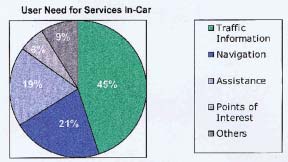 Figure 59. User needs for incar services.
Deployment of navigation systems is growing rapidly in Europe. More than 1 million units were sold in 2000. TrafficMaster delivers information on a 3-minute cycle. The detection system initially consisted of infrared detectors 2 to 3 km apart using a GSM connection to transmit speed and delay time. The second-generation data collection equipment includes license plate readers that read the center four characters and use infrared at night. GSM is still used for communications. In the United Kingdom, about 60 percent infrared and about 40 percent license plate readers are deployed. The next generation of deployment will look at advanced floating car data and will be geared for lower-class roads.
In other parts of Europe, TrafficMaster installs a "black box" in the vehicle. It is called "advanced" because it does exception reporting, not periodic reporting, which saves communication costs. The Waypoint travel times are programmed into the in-vehicle black box and it compares travel times along links with preprogrammed "normal times." The reduction in communication costs is significant, but it is the most expensive way of collecting data. TrafficMaster is planning to deploy 50,000 units in Italy by mid-2002. The approach is used somewhat in Germany. The best applications for probe vehicles are long-distance trucking and regional/local fleets. TrafficMaster bundles the service with its fleet management system and barters simple fleet management for probe data.
TrafficMaster coverage includes the following:
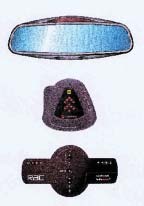 Figure 60. Traffic alert devices.
Alert devices are simple roadside-enabled devices. It is a marketing device that uses the mobile phone system platform. It uses a four-digit number, "1740," which works for all mobile phones. Some carriers also market their own numbers. It provides cell-specific information and generates revenue from using the cell phone minutes. There is revenue sharing between TrafficMaster and the carriers. This service generates more than 5 million calls monthly. The average length of a call is 30 seconds. The U.K. cell phone services charge per second for calls. Carriers promote the number, and the devices were largely given away. The purpose was to provide early devices to stimulate market awareness and entry.
"Freeway" speech devices receve a data dump from roadside transmitters. The data are filtered for direction of travel and are presented in simple speech. The service only has motorway coverage. It costs approximately $110 to buy, is battery powered, and has a $45 per year fee for the service.
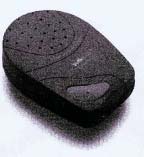 Figure 61. Freeway speech device.
"Oracle" works like Freeway, but it is an original equipment manufacturer (OEM) device. It is built in and can override the stereo audio. To date, about 400,000 to 500,000 per year are being sold. It is becoming a standard on a few auto models. Some OEMs provide a free 1-year trial subscription; otherwise, the owners are subject to the same $45 yearly fee as for the Freeway device.
The "YQ" is an in-vehicle display system (not a navigation system) that provides national information. It costs $225 to buy and has a $150 annual subscription fee. To date, 50,000 units have been sold. YQ offers predefined map views with dynamic data.
TrafficMaster also has worked with Motorola to develop an off-board navigation system called "SmartNav." Market research indicated that three user groups are interested in navigation: high-tech/multimedia-oriented people, comfort-oriented people, and safety-oriented people. These three groups make up the majority of the population. The off-board navigation system targets the latter two user groups. SmartNav is driven by speech and operator interaction, and costs less than half of the price of a navigation system. The user pays for the system when he/she asks for a route. The unit combines live traffic information along with navigation and will be launched in early 2002. The price has not been announced yet, but it is expected to be less than $1.50 per route request. Visit www.smartnav.net for more information. TrafficMaster is also developing an interactive voice platform that will be cheaper than the device-based offboard navigation system.
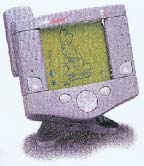 Figure 63. YQ display system and monitor.
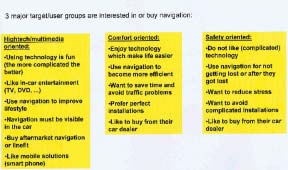 Figure 64. SmartNav user groups.
Romanse is a project to develop a ROad MANagement System for Europe. It is deployed in Hampshire County in the United Kingdom. Visit www.romanse.org.uk for more information. Romanse deploys urban congestion signs that use low-power radio and no commercial communications, which provide significant costs savings. Two radio stations broadcast from the Southampton TCC. To provide private-sector access to the data, an Internet service provider linkage was created by mirroring the database outside the firewall. The data are provided for free and no license is required.
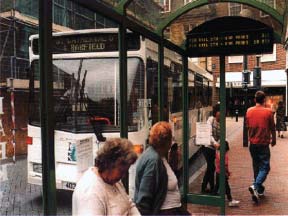 Figure 65. Bus arrival information, Southampton.
Romanse also provides substantial parking and transit information to its users.
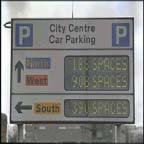
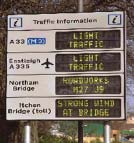
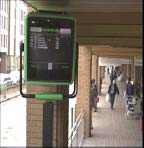
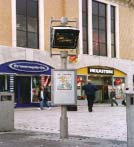
Figure 66. Parking information (left) and bus information (right), Southampton.
According to the research conducted as part of the Romanse project, ITS should not be isolated, but it must be part of an integrated transport policy. Surveys related to urban congestion signs showed that satisfactory network improvement could be achieved with a 20 to 30 percent diversion. The public likes the signs, and 10 to 12 percent will divert on the basis of parking data provided. Greater than 80 percent of the public notices and uses the signs. The message on the sign is the key to usability.
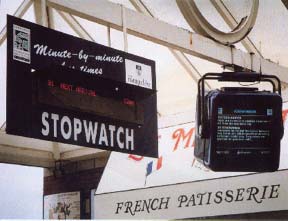 Figure 67. Bus information, Southampton.
| << Previous | Contents | Next >> |