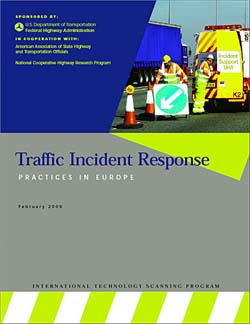
Traffic Incident Response: Practices in Europe
Table of Contents and Executive Summary
|
- Executive Summary
- 1. Introduction
- 2. General Observations and Findings
- 3. Programs and Institutions
- 4. Tactical and Onscene Operations
- 5. Communications and Technology
- 6. Additional Observations of Specific Practices
- 7. Summary of Recommendations
- 8. References and Web Sites
- Appendices
- Tables
- Table 1: Team meetings
- Table 2: Types of host organizations represented in meetings
- Table 3: Sites visited during the scan
- Table 4: NTIMC topics and issues
- Table 5: NTIMC issues for traffic incident management programs and institutions
- Table 6: NTIMC issues for traffic incident management onscene operations
- Table 7: NTIMC issues for traffic incident management communications and technology
- Table 8: Safety priorities for handling incidents
- Table 9: Transportation centers visited by team
- Figures
- Figure 1: Scan Team Members
- Figure 2: AmeyMouchel incident support unit
- Figure 3: Research and demonstration facility in the Netherlands
- Figure 4: Images from virtual training example
- Figure 5: Auto club service vehicles
- Figure 6: Examples of high-visibility garments for responders
- Figure 7: Examples of vehicle markings
- Figure 8: Retroreflective dots used to define vehicle shape
- Figure 9: German end-of-queue warning vehicles
- Figure 10: Example of permanent diversion route symbol sign
- Figure 11: Example of variable speed limit in Germany
- Figure 12: Swedish road service patrol vehicle
- Figure 13: GRIP demonstration signs in the Netherlands
- Figure 14: Powermoon lighting system
- Recommendations
- Recommendation 1: National Unified Goal for Incident Response
- Recommendation 2: Incident Responder Relationships
- Recommendation 3: Integration of Practitioner and Research Perspectives
- Recommendation 4: Incident Response Performance Measures
- Recommendation 5: Incident Response Training
- Recommendation 6: Private-Sector Role
- Recommendation 7: Role of Transportation Agency Personnel
- Recommendation 8: Incident Command and Coordination
- Recommendation 9: High-Visibility Garments
- Recommendation 10: Buffer Zone
- Recommendation 11: Visibility and Positioning of Response Vehicles
- Recommendation 12: Safety of Incident Responders Using Extrication Equipment
- Recommendation 13: Enhancements for Incident Response Vehicles
- Recommendation 14: Increased Authority for Transportation Agency Personnel
- Recommendation 15: Procedures for Restoring Roadway Capacity
- Recommendation 16: Clearance Time Targets
- Recommendation 17: Removing Fatalities from Incident Site
- Recommendation 18: Coordination of Tactical Response
- Recommendation 19: Response Dispatch
- Recommendation 20: Welfare of Road Users Upstream of Long-Duration Incidents
- Recommendation 21: End-of-Queue Advance Warning
- Recommendation 22: Preplanned Diversion Routes
- Recommendation 23: Variable Speed Limits
- Recommendation 24: Coordinated Traffic Information Centers
- Recommendation 25: Improving Communication Practices
Sponsored by:

In cooperation with:
- American Association of State Highway and Transportation Officials
- National Cooperative Highway Research Program
FHWA-PL-06-002 HPIP/1-06(3.5)EW
Notice
The Federal Highway Administration provides high-quality information to serve Government, industry, and the public in a manner that promotes public understanding. Standards and policies are used to ensure and maximize the quality, objectivity, utility, and integrity of its information. FHWA periodically reviews quality issues and adjusts its programs and processes to ensure continuous quality improvement.
Technical Report Documentation Page
- Report No.: FHWA-PL-06-002
- Government Accession No.:
- Recipient's Catalog No.:
- Title and Subtitle: Traffic Incident Response Practices in Europe
- Report Date: February 2006
- Performing Organization Code:
- Author(s): Gene Hawkins, John Conrad, David Helman, Rebecca Brewster, John Corbin, Henry deVries, Gregory Jones, Kevin McGinnis, Ron Moore, Mark Olson, Larry Tibbits, and Michael Zezeski
- Performing Organization Report No.:
- Performing Organization Name and Address:
American Trade Initiatives
P.O. Box 8228
Alexandria, VA 22306-8228 - Work Unit No. (TRAIS):
- Contract or Grant No.: DTFH61-99-C-005
- Sponsoring Agency Name and Address:
Office of International Programs
Office of Policy
Federal Highway Administration
U.S. Department of Transportation
American Association of State Highway and Transportation Officials
National Cooperative Highway Research Program - Type of Report and Period Covered:
- Sponsoring Agency Code:
- Supplementary Notes: FHWA COTR: Hana Maier, Office of International Programs
- Abstract:
Effective response to traffic incidents can enhance safety and mobility for both road users and responders. The Federal Highway Administration, American Association of State Highway and Transportation Officials, and National Cooperative Highway Research Program sponsored a scanning study of traffic incident response practices, procedures, and technologies in England, Germany, the Netherlands and Sweden.
During its study, the scan team observed several common attributes among the organizations in each country involved with incident response. They include a national authority with responsibility for coordinating incident response, national transportation agencies with traffic patrols that respond to incidents, clear jurisdictional responsibility for the police authority responding to incidents in an area, coordinated training for all major incident responders, and national auto clubs that provide roadside repair and towing services.
The team developed 25 recommendations for potential implementation in the United States. They include adopting a national goal for incident response, developing national guidance on incident response performance measures, and establishing Transportation Operations Centers of Excellence for incident response research. The recommendations are aligned with the focus areas of the National Traffic Incident Management Coalition, which plans to participate in implementing the team's recommendations.
- Key Words: safety, traffic incident management, traffic incident response, training
- Distribution Statement: No restrictions. This document is available to the public from the: Office of International Programs, FHWA-HPIP, Room 3325, U.S. Department of Transportation, Washington, DC 20590
international@fhwa.dot.gov
www.international.fhwa.dot.gov - Security Classify. (of this report): Unclassified
- Security Classify. (of this page): Unclassified
- No. of Pages: 56
- Price: Free
Form DOT F 1700.7 (8-72)
Reproduction of completed page authorized
Traffic Incident Response Practices in Europe - February 2006 - February 2006
Prepared by the International Scanning Study Team:
| Team Member | Organization |
|---|---|
| John Conrad (Co-Chair) | Washington State DOT |
| David Helman (Co-Chair) | FHWA |
| Rebecca Brewster | American Transportation Research Institute |
| John Corbin | Wisconsin DOT |
| Henry deVries | New York State Police |
| Dr. Gene Hawkins (Report Facilitator) | Texas A&M University |
| Gregory Jones | FHWA |
| Kevin McGinnis | National Association of State EMS Directors |
| Ron Moore | McKinney, TX, Fire Department |
| Mark Olson | FHWA |
| Larry Tibbits | Michigan DOT |
| Michael Zezeski | Maryland State Highway Administration |
and American Trade Initiatives, Inc. for the Federal Highway Administration U.S. Department of Transportation American Association of State Highway and Transportation Officials National Cooperative Highway Research Program
International Technology Scanning Program
The International Technology Scanning Program, sponsored by the Federal Highway Administration (FHWA), the American Association of State Highway and Transportation Officials (AASHTO), and the National Cooperative Highway Research Program (NCHRP), accesses and evaluates innovative foreign technologies and practices that could significantly benefit U.S. highway transportation systems. This approach allows for advanced technology to be adapted and put into practice much more efficiently without spending scarce research funds to recreate advances already developed by other countries.
FHWA and AASHTO, with recommendations from NCHRP, jointly determine priority topics for teams of U.S. experts to study. Teams in the specific areas being investigated are formed and sent to countries where significant advances and innovations have been made in technology, management practices, organizational structure, program delivery, and financing. Scan teams usually include representatives from FHWA, State departments of transportation, local governments, transportation trade and research groups, the private sector, and academia.
After a scan is completed, team members evaluate findings and develop comprehensive reports, including recommendations for further research and pilot projects to verify the value of adapting innovations for U.S. use. Scan reports, as well as the results of pilot programs and research, are circulated throughout the country to State and local transportation officials and the private sector. Since 1990, approximately 70 international scans have been organized on topics such as pavements, bridge construction and maintenance, contracting, intermodal transport, organizational management, winter road maintenance, safety, intelligent transportation systems, planning, and policy.
The International Technology Scanning Program has resulted in significant improvements and savings in road program technologies and practices throughout the United States. In some cases, scan studies have facilitated joint research and technologysharing projects with international counterparts, further conserving resources and advancing the state of the art. Scan studies have also exposed transportation professionals to remarkable advancements and inspired implementation of hundreds of innovations. The result: large savings of research dollars and time, as well as significant improvements in the Nation's transportation system.
Scan reports can be obtained through FHWA free of charge by e-mailing international@fhwa.dot.gov. Scan reports are also available electronically and can be accessed on the FHWA's Office of International Programs Web Site at www.international.fhwa.dot.gov
International Technology Scan Reports
International Technology Scanning Program: Bringing Global Innovations to U.S. Highways
All Publications are Available on the Internet at www.international.fhwa.dot.gov
Safety
- Safety Applications of Intelligent Transportation Systems in Europe and Japan (2006)
- Roadway Human Factors and Behavioral Safety in Europe (2005)
- Traffic Safety Information Systems in Europe and Australia (2004)
- Signalized Intersection Safety in Europe (2003)
- Managing and Organizing Comprehensive Highway Safety in Europe (2003)
- European Road Lighting Technologies (2001)
- Commercial Vehicle Safety Technology and Practice in Europe (2000)
- Methods and Procedures to Reduce Motorist Delays in European Work Zones (2000)
- Innovative Traffic Control Technology and Practice in Europe (1999)
- Road Safety Audits - Final Report and Case Studies (1997)
- Speed Management and Enforcement Technology: Europe and Australia (1996)
- Safety Management Practices in Japan, Australia, and New Zealand (1995)
- Pedestrian and Bicycle Safety in England, Germany, and the Netherlands (1994)
Planning and Environment
- Transportation Asset Management in Australia, Canada, England, and New Zealand (2005)
- Transportation Performance Measures in Australia, Canada, Japan, and New Zealand (2004)
- European Right-of-Way and Utilities Best Practices (2002)
- Geometric Design Practices for European Roads (2002)
- Wildlife Habitat Connectivity Across European Highways (2002)
- Sustainable Transportation Practices in Europe (2001)
- Recycled Materials in European Highway Environments (1999)
- European Intermodal Programs: Planning, Policy, and Technology (1999)
- National Travel Surveys (1994)
Policy and Information
- European Practices in Transportation Workforce Development (2003)
- Intelligent Transportation Systems and Winter Operations in Japan (2003)
- Emerging Models for Delivering Transportation Programs and Services (1999)
- National Travel Surveys (1994)
- Acquiring Highway Transportation Information from Abroad (1994)
- International Guide to Highway Transportation Information (1994)
- International Contract Administration Techniques for Quality Enhancement (1994)
- European Intermodal Programs: Planning, Policy, and Technology (1994)
Operations
- Traffic Incident Response Practices in Europe (2006)
- Superior Materials, Advanced Test Methods, and Specifications in Europe (2004)
- Freight Transportation: The Latin American Market (2003)
- Meeting 21st Century Challenges of System Performance Through Better Operations (2003)
- Traveler Information Systems in Europe (2003)
- Freight Transportation: The European Market (2002)
- European Road Lighting Technologies (2001)
- Methods and Procedures to Reduce Motorist Delays in European Work Zones (2000)
- Innovative Traffic Control Technology and Practice in Europe (1999)
- European Winter Service Technology (1998)
- Traffic Management and Traveler Information Systems (1997)
- European Traffic Monitoring (1997)
- Highway/Commercial Vehicle Interaction (1996)
- Winter Maintenance Technology and Practices - Learning from Abroad (1995)
- Advanced Transportation Technology (1994)
- Snowbreak Forest Book - Highway Snowstorm Countermeasure Manual (Translated from Japanese) (1990)
Executive Summary
Recent U.S. transportation studies have shown that 50 to 60 percent of all congestion in urban areas is caused by nonrecurring events and about half of that is caused by traffic incidents such as crashes, spilled loads, and disabled vehicles. That proportion is substantially higher on rural highways. Effective response to these incidents can have a significant benefit on traffic safety and mobility in both urban and rural environments. This scanning study was conducted to examine programs and practices that provide coordinated response to traffic incidents.
In April 2005, a team of 12 incident response specialists from the United States visited four European countries to assess and evaluate various practices for responding to traffic incidents. Team members included transportation agency personnel from State agencies and the Federal Highway Administration (FHWA) and individuals representing several perspectives involved in incident response, including police, fire, emergency medical services, trucking, and research. During the 2-week scan, the team met with members of about 30 organizations representing a broad range of incident response stakeholders. From these hosts, the team heard numerous presentations about traffic incident response practices from a variety of perspectives, including road authorities, fire departments, police agencies, emergency medical services (EMS), automobile clubs, recovery providers, and other groups. The team also saw many examples of responder equipment. From the information obtained during the scan, the team identified several areas where practices in the United States have the potential to be improved. This report describes the team's findings and recommendations.
The traffic incident response (TIR) study began in December 2003 with the completion of a desk scan that recommended England, Germany, the Netherlands, and Sweden as the four countries to visit during the trip. The initial team meeting occurred in June 2004 in Washington, DC, and the trip took place April 8-24, 2005. The purpose of the trip was to identify practices, issues, challenges, and innovative procedures that the host countries use in responding to incidents. The major focus of the team members was on the activities and coordination efforts that take place after an incident is detected. The team members were interested in a wide range of perspectives, including those of transportation agencies (at all levels) and emergency responders (fire, police, EMS), as well as removal efforts, traffic control at the incident site, communication between the various stakeholders, and related issues.
The team's recommendations can best be appreciated if one has an understanding of the working relationships among and between the pertinent organizations in the various countries. There were several generally common attributes among the organizations in each country involved in incident response:
- A national agency or authority assumed some responsibility for coordinating incident response and/or motorist information activities. The agency varied among the countries, but each country generally had a leading group. Several countries also had some type of national directive or mandate to address traffic incident management.
- Some national transportation agencies had national or regional traffic patrols that provided traffic control and limited motorist assistance to drivers and incident responders.
- The police authority responding to incidents had clear jurisdictional responsibility. Unlike in the United States, where several police agencies may have jurisdiction at the site of an incident (State, county, city), the countries visited had one police agency with jurisdiction at a particular scene. That agency might be a local or regional one, but it would be the only police responder at an incident scene. As a result, these responders received specialized training associated with freeway incidents.
- Local fire departments had significant resources and training for incident response efforts. Some fire departments had response equipment that provided the ability to remove vehicles and debris from the roadway.
- Emergency medical services were provided at a level comparable to or higher than the paramedic level found in the United States, and they were highly coordinated with police, fire, and major incident responders. In some countries visited, medical response included the dispatching of a doctor to the incident site and the use of helicopters for medical responder transport.
- One or more national auto clubs provided roadside repair or towing services to members. In most countries visited, a large proportion of drivers are members of an auto club. In a large majority of cases, auto club responders are able to provide roadside vehicle repairs that allow motorists to continue their trip. Response vehicles often have the additional capability of towing vehicles for short distances off the motorway to a place of safety. Response times from these private motor clubs were short enough that the transportation agency service patrols did not have to concentrate on providing duplicate services.
- In some countries visited, recovery companies are contracted through the road agency or police to respond to incidents on controlled-access highways. These recovery specialists were required to meet minimum qualifications and response time criteria to maintain their contracts.
Findings and Recommendations
The team members learned about many interesting practices, policies, technologies, and programs during the scan. At the end of the 2-week visit, the team met for a day to review the scan findings and develop 25 recommendations for potential implementation in the United States. The team members recognize that some of these recommendations may already be in place at some locations in the United States, but they believe they should be implemented uniformly at the State and/or national level. The recommendations are organized to be consistent with the three focus topics identified by the National Traffic Incident Management Coalition (NTIMC): 1) programs and institutions, 2) tactical and onscene management, and 3) communications and technology. Several team members are involved in coalition activities and the coalition is taking a major role in implementing the recommendations.
Programs and Institutional Issues
Six of the 25 recommendations are associated with programs and institutional issues that represent the strategic aspects of incident response and address how countries, organizations, and individuals approach the basic challenge of developing and coordinating incident response programs. The six recommendations address the following subjects:
- Recommendation 1. National unified goal for incident response
- Recommendation 2. Incident responder relationships
- Recommendation 3. Integration of practitioner and research perspectives
- Recommendation 4. Incident response performance measures
- Recommendation 5. Incident response training
- Recommendation 6. Private-sector role
Tactical and Onscene Operations
Seventeen of the 25 recommendations are associated with tactical and onscene operations issues that address the activities of responders at an incident site and the onscene coordination of the various responders. The 17 recommendations address the following subjects:
- Recommendation 7. Role of transportation agency personnel
- Recommendation 8. Incident command and coordination
- Recommendation 9. High-visibility garments
- Recommendation 10. Buffer zone
- Recommendation 11. Visibility and positioning of response vehicles
- Recommendation 12. Safety of incident responders using extrication equipment
- Recommendation 13. Enhancements for incident response vehicles
- Recommendation 14. Increased authority for transportation agency personnel
- Recommendation 15. Procedures for restoring roadway capacity
- Recommendation 16. Clearance time targets
- Recommendation 17. Removing fatalities from incident site
- Recommendation 18. Coordination of tactical response
- Recommendation 19. Response dispatch
- Recommendation 20. Welfare of road users upstream of longduration incidents
- Recommendation 21. End-of-queue advance warning
- Recommendation 22. Preplanned diversion routes
- Recommendation 23. Variable speed limits
Communications and Technology
Two of the 25 recommendations are associated with communication and technology issues that address how responders communicate with each other (particularly interagency communications) and with travelers, and how technologies can be used to improve incident response and management. The two recommendations address the following subjects:
- Recommendation 24. Coordinated traffic information centers
- Recommendation 25. Improving communication practices
Additional Observations
In addition to the recommendations, the team observed many unique, interesting, or otherwise noteworthy practices and technologies that team members believed were worth describing to U.S. practitioners. No recommendations are associated with these observations; they are merely provided as seeds for thought. The findings include the following:
- A service patrol vehicle in Sweden with several unique features
- Use of motorcycles for incident response activities
- Equipping auto club assistance responders with computer diagnostic equipment
- Widespread use of automated enforcement for red-light running and speeding
- Use of cell phone cameras to send patient information to hospitals
- Use of advanced hardware for transporting patients to the ambulance and portable fire suppression systems
- Use of software to identify cut points by vehicle model when using extrication equipment
- Use of virtual training with coordinated training of all perspectives of incident responders
- Portable lighting that minimizes glare for approaching vehicles
| Next >> |