U.S. Department of Transportation
Federal Highway Administration
1200 New Jersey Avenue, SE
Washington, DC 20590
202-366-4000
In the United States, we consider the pay-as-you-go approach to be our traditional project financing method. The pay-as-you-go approach uses a combination of Federal grant assistance and State revenues to pay contractors. The traditional system has functioned adequately through the years, but the rapid expansion of infrastructure needs in relation to the available funding has created a desire for alternative financing methods. More specifically, alternative funding sources and alternative payment mechanisms have the potential to improve the speed of delivery and the quality of our national infrastructure.
European highways agencies are taking a "whole-life" approach to financing, designing, building, and maintaining their national infrastructure. They are asking the private sector to compete for the entire project, including financing, and incorporate payment methods as an integral part of the plan to ensure construction quality, road maintenance, road availability, and safety performance. A widespread use of concessions is found at one end of the spectrum, with a virtual transfer of ownership of the asset to the private sector for 15 to 30 or more years. In less aggressive strategies, PPPs are being formed to overcome sociopolitical barriers without transferring the burden of long-term financing or maintenance to the private sector.
This chapter discusses alternative financing through an examination of alternative funding sources and alternative payment mechanisms. A series of PPP case studies is presented, but the more aggressive method of concessions is left for discussion in later chapters. The scan team found the use of concessions and performance contracting to be so prevalent that this report dedicates entire chapters (Chapters 5 and 7) to those subjects. It should be noted that many European countries are aggressively employing concessions and performance contracting in most of their long-term strategic plans.
Two primary differences must be considered in the discussion of European alternative financing. First, the countries visited on the scan have a very limited amount of taxes dedicated to transportation needs. This situation means that gasoline taxes and other transportation-generated revenues are not earmarked for transportation projects, but are put into a general fund with other taxes. The general funds provide money for a variety of needs, including transportation projects, in amounts based more on the political priorities than on the source of the revenues. The second difference is that European governments do not have the ability to use tax-exempt financing for public transportation projects, as is the case in the United States. Although this means that interest rates are higher for some European projects, it also means that such projects are not subject to the management contracting rules applicable to U.S. projects financed with tax-exempt debt. (Internal Revenue Service [IRS] rules require contracts for projects financed with tax-exempt bonds to be structured within safe harbors that may limit the operations/maintenance term or the form or amount of contractor compensation. See IRS Revenue Procedure 97-13, and Sections 141(b) and 145(a)(2)(B) of the Internal Revenue Code of 1986, as amended.) The absence of tax-exempt financing in Europe makes private financing much more competitive with public financing. For example, in the United Kingdom, the interest savings realized when using publicly guaranteed funds, in lieu of private funds, is sometimes less than 1 percent.
Alternative funding sources in Europe include a combination of bond and bank financing. Private financing is much more commonly used than in the United States. In some cases, governments need to use alternative financing because they have reached ceilings for public debt. In others, private financing is simply the best solution for the project. No matter the motivation for the use of alternative funding sources, private financing creates a contract administration environment that is substantially different from that when financing is obtained from the public sector. Particularly where bank financing is used, if repayment is dependent on project revenues (whether in the form of tolls or other user fees including shadow tolls), the lender will want to play an active role in contract administration. The entire contract administration lifecycle is affected, from programming and design to administration and quality control. If the United States wishes to employ alternative financing and continue to deliver a quality product, all of these elements must be considered.
The primary funding mechanism in Europe is similar to the traditional U.S. pay-as-you-go system. Most of the national investment in surface transportation infrastructure is funded through the annual budget allocation process, as in the United States. For instance, in the United Kingdom money is budgeted on a 3-year cycle and is appropriated annually. The Treasury funds municipalities separately. The United Kingdom also was the only country visited that has a tax dedicated to highways. In 2000, an act dedicated a portion of transportation taxes to transportation projects, but this has not been a popular concept with the Treasury and it is unclear whether it will continue. The balance of the investment in the national highway system in the United Kingdom is funded with bank financing through the use of concessions or PPPs.
The EIB was created by the Treaty of Rome in 1958 and is the EU's financing institution. The shareholders of the EIB are the 15 Member States of the EU. The core objective of the EIB is to support a balanced development of the EU, and the majority of loans are made to projects in regional development areas. The EIB has a special focus on PPPs and PFIs. A number of the projects in Portugal and England that were visited on the trip and described in this report were financed by the EIB.
The EIB operates by reviewing the project and credit quality of the proposals brought to it by public and private promoters. It then lends to the promoters, either directly or indirectly through banks. The majority of loans are funded on the capital markets. The indirect lending is principally for small projects.
Through the EIB, the EU has turned to PPPs as a preferred method of providing public infrastructure. The speed of implementation and the efficiency gains resulting from the cooperation are drivers behind this choice. One consideration of the EIB is the availability of private-sector capital, although this is not an important factor in all countries. What is more important is the benefit from private-sector efficiencies and the capacity to share and manage risks. The private sector, seeing the opportunities, has responded positively and is increasingly proactive in proposing PPP structures for individual projects or even entire regions.
Guy Chetrit of the EIB summarized PPPs and their role in Europe (Chetrit 1999).
PPP are an additional financial instrument to support capital investment in economic and social infrastructure for public services. PPP are valuable because of their positive contribution in management, cost effectiveness, quality of service--they complement scarce public funding. PPP offer a more flexible approach to ownership, risk sharing, organization and regulation. However, they require appropriate control by contract or regulation to protect the public interest.
The ultimate objective of any project, including PPP, is to improve the overall rate of return and the public interest. EIB supports PPP as a generally efficient means of achieving this objective. We encourage flexibility in PPP frameworks and in structuring transactions so that the structure chosen is appropriate to the business conditions of each country and the particular sector concerned. Flexible structures and a medium to long-term view are, in our opinion, the best way to maximize the position impacts of PPP.
Criteria for Public Private Partnerships include:
- Economically viable for the public sector
- Financially viable for the private sector
- Appropriate risk and reward balance for public and private sectors
- Public sector value for money
Generally, projects, which are considered for PPP, should be socio-economically viable. The majority of public service projects and investments will, however, not be financially viable on a stand-alone basis. The public sector will therefore choose the appropriate form of participation to ensure that the project has the appropriate risk-reward balance to make it financially viable for the private sector. In order to make PPP a long-term feature, the private sector will require appropriate returns while the public sector will ensure that it is acquiring the service at an appropriate price.
The following table shows a variety of structures used in the EU, ranging from the 100 percent publicly funded road networks shown in the bottom right-hand corner to the 100 percent private user-financed projects. In between, there are a large number of alternative structures that have been selected in accordance with project characteristics. A number of the case studies described in this report were financed through the EIB.
| CONSTRUCTION CONTRACT | Private sector-owned | Mixed Public/Private | Public Sector | |
|---|---|---|---|---|
| Fixed Price | User Fee | Dublin Ring Road (IR), Skye Bridge (UK), Second Severn Crossing (UK), ECT Port Terminal in Rotterdam (NL), Tagus Bridge (PT), IPP (IT, PT, UK), Manchester Metrolink 2 (UK) | Great Belt Link (DK) |
|
| User Fee plus govt subsidy | West Coast Mainline (UK), Thameslink 2000 (UK), Passenger Rail Franchises (UK), Croydon Tramlink (UK), Manchester Metrolink 1 (UK), Channel Tunnel Rail Link (UK) | Rion Antirrion Bridge (GR) Spata Airport (GR) Channel Tunnel Rail Link (UK) |
Essi Motorway (GR) | |
| No User Fee | DBFO Roads (RU), Wijkertunnel (NL) | Belgian Ports, Spanish Ports, Greek Ports, Irish Ports,Delta 2000 (NL) | ||
| Cost Plus | User Fee | Autopista Castedalenis (SP) Eurotunnel (F/UK) |
Tunnel Valvidrera (SP), Most French Motorways, Most Italian Motorways, French Ports, Some Italian Ports, Some Portuguese Ports | French Railways, German Railways, Danish Ports, Pathe Motorway (GR) |
| User Fee plus govt subsidy | TAV (Rail-IT) | Most EU Motorways and national road networks | ||
| No User Fee |
Recent U.S. DOT legislation has allowed the States and territories to establish state infrastructure banks (SIBs). In 1995, the National Highway System Act initially authorized 10 States to establish such infrastructure banks to accelerate State-approved transportation projects by making loans and providing other forms of credit assistance. In 1997, the U.S. DOT Appropriations Act authorized all interested States to establish such banks. By 2001, approximately 40 States and territories had established SIBs; by August 2000, these banks had executed $749 million in loans and other credit instruments in order to advance $5.2 billion in critical transportation projects.
SIBs have been capitalized (i.e., initial deposits have been made) through a combination of Federal and State funds. Initial deposits have been made from small amounts of Federal startup or seed capital, as well as through the earmarking of a portion of regular Federal-aid highway and transit funds. The process of earmarking is referred to as "capitalization" of Federal grant assistance funds. In addition, States have matched Federal deposits from their general fund balances and/or general revenues. In some cases, States have matched at the minimum required rate (generally 20 percent), while in other cases States have contributed significant amounts of funds beyond the minimum requirements. In addition, some States have decided to invest State funds in their SIB on an annual or continuing basis, thus increasing the resources available for credit assistance to transportation projects.
Given the variation in State contribution/investment policies, current SIB balances range from several million dollars to more than $1 billion. In addition, SIB operational policies--including lending guidelines--differ depending on States' needs, priorities, and political environment. Accordingly, the effectiveness of SIBs in leveraging resources and stimulating transportation investment will vary markedly from State to State.
In addition to the SIBs encouraged by Federal legislation, a number of development banks have been established at the State and regional level. Some of these banks may be referred to as investment banks, others as economic development banks, and still others operate as government banks. Regardless of the terminology employed, the essential mission of these banks is the same: to ensure economic stability and promote economic development in their respective geographic areas, often with a related goal of growing the tax base and/or tax collections. A wide variety of economic incentives are offered: loans, credit assistance, tax incentives or abatements, donation of public property, and infrastructure improvements. Because of their broad developmental focus, these banks may not provide credit assistance targeted exclusively to transportation projects. In addition, since they are established to promote development in a given State or region, their geographic focus may be somewhat parochial/limited. In fact, one State development bank may develop a package of loans and incentives to lure a company from another, often neighboring, jurisdiction. Accordingly, development banks may not reflect either the regional coordination or perspective commonly seen in EIB operations, or the sharp transportation focus found in SIBs.
A Swedish delegation joined the scan team in the Netherlands. Sweden has a much different approach to alternative finance and contract management. The Swedish government places (sells) its general debt--including debt used for transportation projects--in Japan. The benefit of this practice is that Sweden benefits from very low long-term interest rates currently being paid in Japan--less than 1 percent--and protects itself against currency risk with an appropriate hedging strategy. Sweden also allows local governments to accelerate approved transportation projects by arranging their own financing, and simply credits the localities' investment, without calculating interest, in the year that the project would have been completed without local government financing. This practice effectively allows local governments to make an interest-free loan to the central government if they wish to accelerate their projects. A more detailed review of the Swedish practice of operating their "DOT" as seven profit centers was beyond the scope of this scan, but it warrants assessment and evaluation in future studies.
The Netherlands provided the scan team with two primary examples of alternative financing. The first is a small project, Sijtwende, jointly developed among RWS, KWS Contractors, and Structon Integrale Project Managers. Sijtwende is a combination roadway project/residential development.
In 1938, RWS planned to build a roadway connecting state routes A4 and N44. The state has owned the right of way for the project for many years. For more than 20 years the project had met with public resistance, and construction could not proceed. The roadway is located in a historic and affluent portion of town. The citizens were concerned that the project, as originally proposed, would have had a detrimental impact on the environmental, noise, and aesthetic qualities of their community.
The project is finally being constructed pursuant to a PPP agreement among the government of the Netherlands and the local developer joint venture. A local developer conceived the idea of developing a residential community on the property owned by RWS, with the roadway constructed below grade in order to maximize the buildable land and the value of the homes. There are two tunnels, each 1,785 meters in length. The development includes 700 residences, including multistory buildings with apartments that will be sold to individual owners as well as townhomes. The tunnels run through the center of the project and are covered by a public park.
As of the date of our site visit in June 2001, much of the tunnel construction was already completed. The route is scheduled to open in 2002. The first phase of the residential development has already been completed, and all homes have been sold. As each home is sold, the proceeds allocable to land value are paid to RWS, and the proceeds allocable to the value of the improvements are paid to Sijtwende. The PPP agreement specifies how the purchase price will be allocated between land and improvements. The parties estimate that approximately 15 percent of the cost of construction of the tunnel will be paid by the land sales proceeds, which is approximately 35 percent of the additional cost to the government of building the project as a tunnel. The government was willing to enter into this arrangement notwithstanding the additional cost, since it enabled a long-delayed, critical project to proceed.
A number of agencies in the United States have explored joint development opportunities for transportation projects. In the highway arena, there are a number of constraints on joint development. 23 U.S.C. § 111 requires property on highways that have received Federal-aid to be used exclusively for highway purposes (with certain exceptions). In addition, the management contracting rules promulgated by the IRS restrict long-term private operations of projects funded with tax-exempt financing. The underlying premise for these constraints appears to be a belief that public property should be reserved for public use, that public funds should not be used to benefit specific individuals or entities, and that public agencies should not exercise the power of eminent domain except for a public purpose. The FHWA does not currently have a formal policy on joint development, other than the rules based on Section 111. Its prior policy (PPM 90-5 in Chapter 7 of the Federal-Aid Highway Program Manual) has been rescinded and has not been replaced by any other policy statement or regulatory authority.
In contrast, the FTA is actively encouraging transit agencies to explore joint development opportunities for U.S. transit projects. Congress has specifically authorized use of grant funds to support joint development projects "which enhance the effectiveness of any mass transportation project and are physically or functionally related to such mass transportation project or which create new or enhanced coordination between public transportation and other forms of transportation, either of which enhance urban economic development or incorporate private investment including commercial and residential development" as well as "other non-vehicular capital improvements that the Secretary may decide would result in increased mass transportation usage in the corridor." See 49 U.S. Code 5309(a)(1)-(5) and (7). Under FTA's policy statement regarding joint development, the present value of the cash payment or revenue stream from the private development must equal or exceed the fair market value or the appraised value of the property used for the private development, taking highest and best transit use into account. See FTA publication, Innovative Financing Techniques, Chapter 3. It is unclear whether the Sijtwende project would have met those standards.
Joint development has been used for non-Federal-aid projects by many State and local agencies, including for roadway improvements, parking facilities, pedestrian overpasses that improve access to shopping areas, and mall and beautification projects.
The Project Development Guide published by FHWA's Office of Real Estate Services includes the following examples of joint development projects (found in Chapter 14 of the guide):
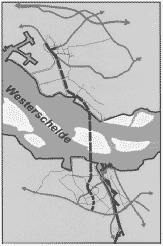
The second example of alternative financing reviewed in the Netherlands is the Westerschelde Tunnel. The financing for the project is unique in that the government is providing the financing for the tunnel but, upon completion, the government plans to sell the tunnel to the private sector for operation and maintenance. The original plan was to have the tunnel constructed entirely through private finds. However, the project proved to be too risky for the private-sector financiers. The government decided to share the risk by paying for the construction and then selling shares in the project, as a going concern, to the private sector. Revenues will then be generated from the tunnel through the use of tolls.
 The
tunnel is a fixed link between Zeeuwsch-Vlaanderen and Central Zeeland. As
early as the 1930s, there were initiatives to improve the crossing of the Westerschelde.
Options for bridges and tunnels were considered, but given financial, environmental,
and ecological issues, a tunnel was chosen. The tunnel is 6.6 km in length.
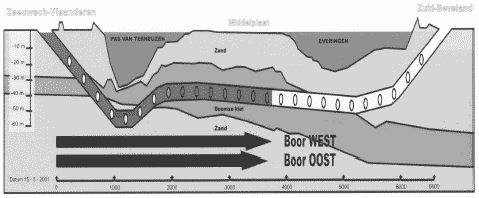
At its deepest point, the tunnel is 60 meters below the Amsterdam Ordinance
Datum. Two 11-meter tunnels will each have two lanes. The tunnel is being bored
with two tunnel boring machines working 24 hours a day, six days per week for
27 months. The total project will take 80 months from design through construction.
When complete, the tunnel will provide an ultimate capacity for 27,000 cars
per day.
The
tunnel is a fixed link between Zeeuwsch-Vlaanderen and Central Zeeland. As
early as the 1930s, there were initiatives to improve the crossing of the Westerschelde.
Options for bridges and tunnels were considered, but given financial, environmental,
and ecological issues, a tunnel was chosen. The tunnel is 6.6 km in length.
At its deepest point, the tunnel is 60 meters below the Amsterdam Ordinance
Datum. Two 11-meter tunnels will each have two lanes. The tunnel is being bored
with two tunnel boring machines working 24 hours a day, six days per week for
27 months. The total project will take 80 months from design through construction.
When complete, the tunnel will provide an ultimate capacity for 27,000 cars
per day.
As previously mentioned, the unusual alternative financing mechanism for this project is in the sale of the asset to the private sector upon completion. The technical complexity and lengthy construction time made the project unattractive for the private sector at the onset of the project. Once the project is complete and the tolls are generating revenue, the public-sector investment will be repaid by the sale. This is an example of a government allocating the risks appropriately to gain the maximum benefit from its private-sector partners.
The use of alternative funding sources has led to a series of unique payment mechanisms in Europe. PPPs typically require the private-sector partners to carry the costs of design and construction much longer than traditional methods. Instead of being paid for the project on the basis of unit prices or progress or in a lump sum upon completion, the private-sector partners are typically considered temporary owners of the completed asset and receive payment over a much longer period of time. Common terms of payments in these ventures range from 15 to 30 years, but France awarded a 79-year concession for the A86 West Loop in 1999 (in effect through 2078).
Obviously, the contract administration implications of these long-term payment mechanisms are much different than traditional U.S. systems.
 Many
of the alternative financing payment mechanisms overlap with virtually every
other section of this report, from contracting techniques to asset management.
However, two particularly applicable payment mechanisms are discussed in this
chapter. They both involve payment tied to usage, rather than tied to construction.
The United States has experience in this type of payment mechanism through "real
tolls" (or simply "tolls"). Tolls have been a successful alternative
payment mechanism in various regions of the United States, but they have met
with political barriers in other regions. Likewise, Europeans have faced political
resistance to tolls. Two alternative payment mechanisms have come to the forefront:
shadow tolls and active payment.
Many
of the alternative financing payment mechanisms overlap with virtually every
other section of this report, from contracting techniques to asset management.
However, two particularly applicable payment mechanisms are discussed in this
chapter. They both involve payment tied to usage, rather than tied to construction.
The United States has experience in this type of payment mechanism through "real
tolls" (or simply "tolls"). Tolls have been a successful alternative
payment mechanism in various regions of the United States, but they have met
with political barriers in other regions. Likewise, Europeans have faced political
resistance to tolls. Two alternative payment mechanisms have come to the forefront:
shadow tolls and active payment.
Shadow tolls are an alternative financing payment mechanism in which the government pays a private-sector partner (PPP, DBFO, or concessionaire) for a project, based on the number of vehicles that use the facility. Traditional sampling methods and high-tech real count mechanisms are in use to count the vehicles for the shadow toll payments. The government receives the initial project financing from the private-sector partner, and the partner takes the risk/ reward for the number of vehicles that use the road. In addition, the operational nature/characteristics of the shadow toll payments may assist the government in more effectively managing its debt because shadow toll payments are determined and made on a periodic basis--most commonly on an annual basis. Accordingly, the government and investment community may properly consider these shadow toll payments to be an item of operating expense; as an operating rather than capital expense, it generally need not be included in calculating debt ratios or debt capacity. Such an operating definition thereby provides the government with debt-management flexibility in the event that its revenues fall below expectations or if its cash-flow position deteriorates for some other reason.
Shadow tolls started in the United Kingdom under the DBFO program. At the time of this scan, the British Highways Agency had brought eight DBFO projects to financial close and announced seven others (one in conjunction with the Scottish Office). The estimated capital value of the road plans within the DBFO program is just less than £1.3 billion (approximately US$2 billion). In cooperation with the Private Finance Panel, the Highways Agency produced a case study of the first eight DBFO projects (DBFO - Value in Roads 1997). The following is an excerpt on the payment methods portion of that report:
Payment is made for the provision of the road service. The Agency pays DBFO Company an amount, which is based on the number and type of vehicles using the road, with adjustments made for lane closure and safety performance. The payment mechanism was structured to meet Government policy objectives for the trunk road network and PFI requirements. It incorporates payment based on the following three criteria:
- Usage/demand - shadow tolls involve payment per vehicle using a kilometer of the project road, in accordance with a tolling structure. They are referred to as 'shadow', as opposed to real, tolls because the Agency, rather than the road user makes the payment for usage. The shadow tolls increase over time in accordance with an indexation formula.
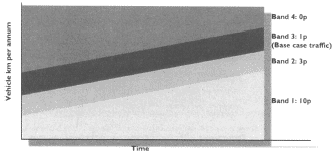
Different payments are due for traffic within different traffic bands and dependent on the length of vehicle. Bidders were asked to bid the parameters of traffic levels for a maximum of four, and a minimum of two, bands, with the proviso that the top band--anything exceeding X vehicle kilometers per annum--must have toll levels set at zero to ensure that the maximum liability of the Agency under the DBFO contract is capped.
Within each traffic band the bidders specified a toll for two categories of vehicle; long vehicles (over 5.2m--which, most importantly, includes HGVs) and short vehicles (less than 5.2m). There is no available method of differentiating between the weights of vehicles, and therefore length measurement was used as a proxy for weight.
Bidders set the bands and tolls from their own assessment of traffic levels. Most bidders opted for four bands with the lowest band representing a cautious view of traffic and tolls within that band set at a level that would cover debt service requirements (but would not provide a return on equity). The figure below shows a typical banding structure proposed by bidders.
- Availability of service - where the project road consists of an existing stretch of road with one or more construction schemes along its length, then (prior to the completion of any construction scheme) shadow toll payments will be made at a reduced level representing the cost of operation and maintenance for the existing road. This level varies substantially depending on the nature of the DBFO project. In the case of the MI-Al project, which is virtually all new build, no payment is to be made until the Permit to Use is issued for the road to open to traffic.
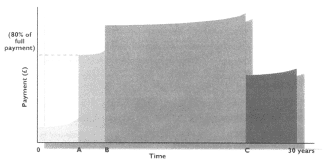
Generally, once the Permit to Use is issued for a construction scheme and the road is open for traffic, DBFO Company receives 80% of the full level of traffic payment. When the construction works are completed and the Agency has issued the Completion Certificate, DBFO Company receives 100% of the traffic payment.
In most cases the toll payments step down again at the time when it is anticipated that the third party debt will have been fully repaid. This reflects the fact that revenue in excess of operating and maintenance costs at that stage is solely return on equity.
The figure below shows a typical payment profile, assuming no variance in traffic or adjustment for lane closure or safety performance. The increase in payment over time during each 'step' results from indexation of tolls. Issue of the Permit to Use is marked 'A', issue of the Completion Certificate is marked 'B', and 'C' shows the point at which third party debt is anticipated to be repaid.
- Performance - There are two aspects to performance payments: safety performance payments and lane closure charges.
One of the Agency's key objectives is to reduce accident levels on the trunk road network. In order to incentivize DBFO Company to address safety it is encouraged to suggest safety improvement schemes for Agency approval. If these improvements are agreed, DBFO Company constructs and pays for the scheme and is recompensed by receiving 25% of the economic cost of each personal injury accident avoided in the following five-year period. Accidents avoided are determined by comparing the actual statistics with data over the three years prior to the implementation of the scheme.
Disturbance and delay caused by lane closure is a significant performance issue to both the Agency and the road user. A deduction is made from the toll payment when lanes are closed. The size of the deduction is dependent on the number of lanes closed, the duration of the closure, the expected traffic at the time of closure (which encourages scheduled closure for maintenance at off-peak times) and the economic value of user delay, which can differ between business and leisure use. Lane closure charges are only made for closure within the control of DBFO Company, for example no deduction is made for closures required by the police (in the case of accidents and emergencies) or utilities.
The Netherlands has used shadow tolls for two tunnel projects and has developed an interesting variation. The Highways Agency sees a potential problem in balancing the need to reimburse the private-sector initiative while meeting the agency's objectives. For the two shadow-tolled projects, the government made payments based on the number of cars that passed through the tunnel. It turned out to be very costly to the government. As another example, for projects where the amount payable for maintenance is fixed, the concessionaire would have a built-in incentive to keep traffic off the road. The Highways Agency now believes that payments should be structured to ensure that the agency's objectives are met. The agency's real problem is with congestion in the municipal community, which is not on the main system where shadow tolls are typically employed. For current projects the agency repays the private-sector investment using a modified shadow toll concept based on lane availability rather than lane usage.
For similar reasons, the United Kingdom also is experimenting with alternatives to shadow tolls. It has found that maintenance may not be optimized through the shadow toll system. The problem is that the shadow toll provider will be compensated for the number of vehicles using the system, even if the system is in poor condition. In essence, a shadow toll could still be paid if the vehicle passes over a poor section of road. Although there are incentives and penalties for maintenance quality written into the contract, the foundation of payment per number of vehicles still exists. One alternative that is being employed by the British Highways Agency is the AMPM.
The AMPM is being developed by the British Highways Agency and has evolved from the shadow toll system. The shadow toll system has worked well for achieving many of the Highways Agency's goals, but it does not encourage active management of the project road to help reduce congestion and increase the reliability of trip times. AMPM consists of three main parts: congestion management, safety management, and service management. This section of the report describes the congestion-management element of the AMPM system. Yogesh Patel, who works with the Procurement Policy Division of the Highways Agency, provided the scan team with the following Summary of Principles for the AMPM system:
Two of the Highways Agency's key objectives are to reduce congestion and to improve journey time reliability. The Congestion Management element is designed to do this by reducing payments for any times that congestion is experienced on the project road. It is considered that the DBFO Company can influence greatly the occurrence and levels of congestion through the effective management of the causes of congestion.
DBFO Company Role in Managing Congestion
The DBFO Company is considered to be in a good position to control and reduce congestion. The DBFO Company will therefore be required to accept the risk of predictable congestion such as roadwork, special events, slow moving vehicles, etc., and the risk of unpredictable congestion such as that due to accidents, poor weather, etc.
Management of these can be achieved through, for example: planning roadwork to be undertaken during off-peak times; liaising with the local authorities, police and other interested third parties to plan for impact of known events, having breakdown and response vehicles on standby; providing additional signing and break down vehicles during special events, placing temporary traffic management during emergencies, etc.
It is recognized that the DBFO Company will have limited control over things that cause recurrent congestion such as sheer volume of traffic demand above the nominal capacity of the road. The Payment Mechanism therefore makes allowances for this such that the DBFO Company does not carry this risk.
Basis of Congestion Management Payment
Tenderers will bid a fixed amount of money for each year of the commission. The amount bid will be divided up into weekly amounts and further divided for each carriageway section (approx 2km in length) and each hour of the day. The amount of weekly payment allocated to each section and each hour will be directly proportional to the expected level of traffic flow based on a rolling average of the number of vehicle kilometers traveled on each section of road for the corresponding hour of the day for the previous four weeks.
Full payment for each section and each hour will be made if:
- The road section satisfies minimum road condition criteria, and
- The target average speed for the road section is achieved.
Failure to meet the required minimum road section performance criteria will result in no payment being made for that road section for that hour. When the average speed falls below the target average speed, payments are reduced as detailed below.
Adjustment of Congestion Management Payment
Payment will be affected by speed and flow with the key features being:
- At all levels of traffic full payment will be made if speeds are above 90 kph.
- Full payment will be made if traffic exceeds the deemed capacity of the road section, even if the speed falls below 90 kph.
- There will be graduation of the level of deduction for both speeds between 60 and 90 kph and between 80 and 100% of capacity.
- A bonus will be paid if flow exceeds 110% and speeds exceed 60 kph.
- The maximum bonus that can be earned is 20% of the payment for the hour and road section, if flow exceeds 120% of capacity and speed exceeds 90 kph.
Fundamental to the success of the new congestion management approach will be the need to give considerable freedom and flexibility to the DBFO Company to manage the flow of traffic. The DBFO Company will be expected to come forward with innovative proposals for managing congestion, some of which may need the Secretary of State to promote Orders. The Secretary of State will therefore give an undertaking not to unreasonably block DBFO Company's proposals. The grounds for objection by the Secretary of State will therefore be limited to the following:
- Has an adverse effect on safety;
- Has an adverse effect on the traveling public;
- Has an adverse effect on other transport networks/modes;
- Has an adverse effect on environment;
- Has an adverse effect on interested third parties;
- Is not consistent with the planning framework;
- Creates an unreasonable future liability for the Secretary of State; or,
- Is unlikely to achieve the intended outcomes.
The British Highways Agency is currently moving forward toward implementation of the AMPM system. This system incorporates the benefits of the shadow toll method and creates a new mechanism for providing better congestion management, safety management, and service management. The U.S. highway community should look at the advantages of this type of payment method and determine if it can be employed in U.S. markets to improve the overall quality of the highway system.
Arizona DOT (ADOT) implemented a form of the AMPM concept on the State Route 68 design-build project. ADOT is using a contractual provision that requires the design-builder to measure
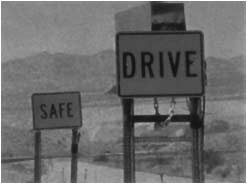
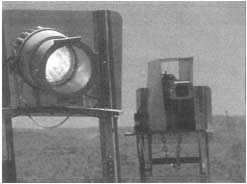
speed consistency and performance through the 13-mile construction work zone. The contract provided a $400,000 travel time budget item that would be drawn against if the target travel time average is exceeded.
Contractual incentives and disincentives would be implemented for performance above or below the contractual standard.
The design-builder elected to deploy an electronic license plate reader system developed by the British company - Computer Recognition Systems. This system uses a camera and a light source to capture license plate images of passing vehicles. The license plate number is taken from the picture by image recognition software, encrypted, and then sent to the central computer at the contractor's office through a high-speed data connection. There is a second camera at the end of the project, which takes a second picture, encrypts that license plate number, and sends it to the central computer. The central computer then attempts to match up license plates that enter and exit the limits of the construction project.
The travel time incentive program is not very visible to the traveling public but they are still enjoying the benefits. Because of this contractual provision, the contractor has made great efforts to limit the delay to people traveling the corridor. The contractor has made sure to limit the number of flagging stations throughout the project, and has scheduled work in such a way that it reduces the impacts to the public.
To date, the contractor has experienced very few times when the average travel time goal has not been met. The license plate reader system is able to match about 11 percent of license plates between the start and finish of the project. This rate is considered good compared with other license plate reading projects around the world and is adequate for the average travel time estimates used on this project.
For additional information, contact: Ron Williams, Arizona DOT (602) 712-7323, or William J. Higgins, Arizona DOT (602) 712-8274.
European highways agencies are working closely with private-sector partners to finance and build projects much faster than traditional methods permit. Projects that are not viable using traditional funding mechanisms, either because of lack of funding or sociopolitical constraints, are being constructed through the use of PPP and other alternative funding sources. These alternative funding sources take a whole-life approach to project design, construction, and maintenance. As discussed in this chapter, the payment methods for these projects range from payment through proceeds of adjacent land sales owned by the government to real tolls paid by the users. As an alternative to real toll payment methods, alternative financing payments are being made through creative methods such as shadow tolls and AMPMs. These payment methods offer solutions that increase price competition from the private sector, but also incentivize and improve quality in the completed and maintained project.
U.S. highway agencies can directly apply these findings to many of their alternative financing methods. The scan team recommends that the following tools be explored in the United States as a means to speed the delivery of our infrastructure and increase the quality of construction and maintenance:
| << Previous | Contents | Next >> |